


Dr Najat Maalla M’jid: “Child Protection Should Be Seen as an Investment, Not a Cost”
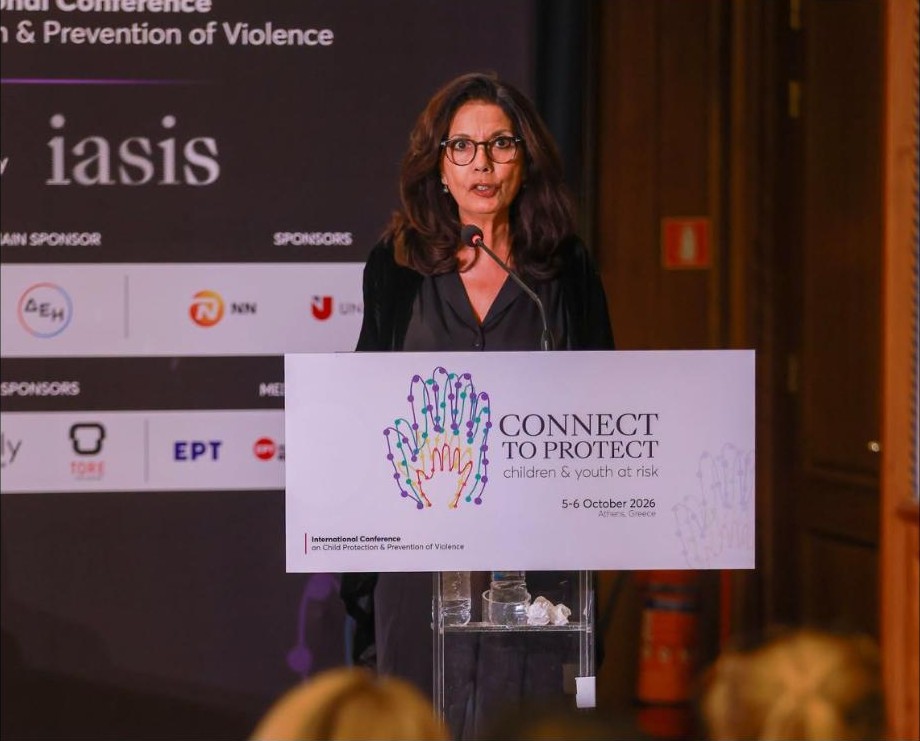
In her speech, Dr Najat Maalla M’jid, Special Representative of the UN Secretary-General on Violence against Children, addressed strengthening child protection systems, turning political commitments into practice, developing community services, building professionals’ capacity, inter-agency cooperation and the importance of preventing violence against children.
In her speech she shared the experience gained during working visits to different countries, the problems found in child protection systems and possible ways to address them.
How effective child protection works at local and community level
Dr Najat Maalla M’jid said that during her mandate as Special Representative she has visited 65 countries. She stressed that these were not tourist trips but in-depth working visits, including meetings with policymakers, children and young people, and visits to institutions and communities.
A key aim of these meetings and discussions was to understand what child protection means at community and local level, how the relevant services work and how accessible they are to children and their families.
The Special Representative stressed the importance of listening to children and young people, encouraging them and involving them in decision-making. She also highlighted the need for civil society organisations, religious leaders, parliamentarians and other stakeholders to take part, so that all actors have a fuller picture of child protection problems and how to solve them.
According to Dr M’jid, an effective child protection system cannot be ensured by political commitments and recurring promises alone. These commitments must be turned into real actions and services available to children and their caregivers in the very communities where they live.
She stressed that children do not live only in administrative centres, capitals or big cities such as Rome. Child protection policies and services must therefore also reach remote settlements and communities.
The Special Representative believes it is necessary to connect the people and institutions involved in child protection at national and local level, and to involve children and young people as full partners.
She placed particular emphasis on this approach, stressing that child protection must be based not only on the work of institutions, but on effective cooperation between people.
Reforming child protection systems and building professionals’ capacity
Turning to the reform of child protection systems, Dr M’jid noted that strengthening them is not just about building new centres or ceremonially opening new services.
In her view, one of the most important components of system reform is investing in people, especially in the capacity of first responders.
She observed that many countries run various capacity-building programmes and a large number of trainings, but at the same time staff turnover is high.
In this situation, it is necessary to identify who the first responders are — the professionals children and their caregivers turn to first for help or support.
The Special Representative stressed that these professionals need a shared practical understanding of child protection, common principles and consistent professional approaches.
She emphasised that as long as child protection principles are not fully built into the foundations of the relevant systems, the necessary progress will not be achieved.
In her view, knowing the articles of the Convention on the Rights of the Child is not enough. It is necessary to understand how these rights can be turned into practical solutions and built into all relevant training and education programmes for professionals.
Dr M’jid stressed that the issue is not just training police officers or judges separately.
In her words, professionals from different sectors must learn and work together, because without a shared understanding of child protection and common approaches, proper information sharing is not possible either.
She described the lack of effective information sharing and cooperation between professional systems as one of the serious problems in child protection.
The impact of political change and the sustainability of community structures
Dr M’jid also addressed the continuity of political commitments.
She noted that in many cases political commitments to child protection depend on elections and changes in government.
As she described it, active work often begins and stakeholders are widely mobilised, but after elections the situation changes. Ministers and responsible officials change, and this can affect the continuity of processes already under way.
The Special Representative stressed the importance of commitment and engagement at the highest political levels, while also emphasising the need to strengthen community and local structures.
She believes that local structures need sufficient capacity and stability so that child protection services continue to function regardless of political change.
Dr M’jid noted that when the child protection system works at community level, and the whole chain of services is properly built, taking into account the community’s characteristics, the population’s needs and social risks, the system can become sustainable and long-lasting.
She placed particular importance on building coordinated and interconnected services at community level as one of the key conditions for effective and continuous child protection.
Decent living conditions for children and socio-economic support for families
Speaking about child protection services, Dr M’jid said she had met children in various countries who did not even have a birth registration.
She presented this as an example of the problems related to protecting children’s rights and access to basic services.
The Special Representative stressed that child protection also means ensuring decent living conditions for children and overcoming poverty.
In her words, it is necessary to make sure that parents and caregivers receive appropriate support.
At the same time, she stressed that family support cannot be limited to parenting programmes or individual courses.
Parents and caregivers need to be empowered, including through expanded economic opportunities and a real possibility to use different services.
In Dr M’jid’s view, protecting children’s rights requires an inclusive education system that is safe, high-quality and accessible to all children without discrimination.
She also highlighted access to health services — not only general health care, but also mental health and sexual and reproductive health services.
According to the Special Representative, access to these services is also important for strengthening the capacity of parents and families.
She noted that health-related problems cannot be seen as the sole responsibility of the health sector.
Dr M’jid stressed the influence of social, economic and cultural factors on health and the need to take them into account when designing child protection policies and services.
Connecting social protection and child protection systems
Dr M’jid stressed the importance of effective links between social protection, social welfare and child protection systems.
She emphasised that these systems must work together so that the support they provide matches the real needs of children and families.
According to the Special Representative, social protection and social welfare systems must be child-sensitive and gender-sensitive.
She highlighted the development of the whole social protection system, while also stressing the need for legal protection.
In this context, Dr M’jid addressed the role of the police and the justice system.
She noted that if the police do not respond properly, if the justice system does not respond as needed, and if these institutions do not recognise their role in protecting children, the system cannot work effectively.
The Special Representative stressed that one of the main problems she has observed is the lack of a complete, interconnected chain of easily accessible services for children and families.
In her view, an effective child protection system requires real cooperation and complementarity between social, health, education, law enforcement and justice services.
The problem of parallel strategies and the need to map existing systems
Dr M’jid also addressed the effectiveness of the many strategies and legal reforms developed in the field of child protection.
She said it is necessary to end the widespread practice of developing separate, parallel strategies.
According to the Special Representative, many countries have an incredible number of strategies, which are often never implemented.
She stressed that the same applies to many legal reforms, whose practical implementation is also not ensured.
In this context, Dr M’jid proposed that instead of continually developing new strategies and reforms, countries should first map everything that already exists.
In her view, it is necessary to review existing services, structures and opportunities, and to strengthen the capacity of teachers, community workers and other professionals.
The Special Representative stressed that investment in developing professionals and strengthening existing services should be seen as investment in the country’s development.
Child protection as an investment, not a cost
Dr M’jid said that real progress in child protection is being made in countries where the importance of protecting children and ensuring their well-being is recognised at the highest political level.
She specified that this means the highest levels of government — the president, the prime minister, the head of government, as well as the ministers responsible for planning and the budget.
According to the Special Representative, it must be clearly understood at these levels that protecting children, ensuring their well-being and strengthening a comprehensive, integrated child protection system are an investment, not simply a cost.
She stressed that if child protection is not seen from this perspective, the system struggles to work effectively.
Dr M’jid also stressed the importance of ministries of planning, budget, economy and finance recognising the return on these investments and their long-term results.
In her words, when these ministries become convinced that developing the child protection system is an investment with positive social and economic returns, their approach truly changes.
Inter-agency coordination, clear roles and accountability
Dr M’jid addressed coordination as one of the most important issues in child protection.
She said she does not like the phrase “lack of coordination”, stressing the need to be clear about what it actually means.
The Special Representative emphasised that solving coordination problems first requires understanding how roles and responsibilities are divided among institutions.
Referring to the various diagrams presented, she stressed the need to define clearly what each institution or actor does, what it is responsible for and to whom it is accountable.
In her words, it is possible to set up many inter-agency committees, but their existence alone does not ensure effective work.
If these committees are not accountable, if roles and responsibilities are not clearly defined, and if there are no clear, publicly available timelines, the system cannot work effectively.
Dr M’jid noted that some countries already apply such approaches, based on a clear division of responsibility and accountability.
She placed particular emphasis on the practical substance of coordination, stressing that cooperation between institutions must be expressed through concrete actions, clear commitments and monitoring of their implementation.
Children and vulnerable groups as full partners
Dr M’jid stressed the need to rethink approaches to children, families and people in vulnerable situations.
She said we must stop seeing poor, vulnerable, neglected or forgotten children and people only as passive recipients of services.
In the Special Representative’s view, they should be seen as full partners.
She stressed that children and families know very well which of the services intended for them work and which do not.
Their participation should therefore be ensured not only in designing and delivering services, but also in evaluating and monitoring them.
In Dr M’jid’s words, the experience of children and families is an important source of information for assessing the effectiveness of services and aligning them with real needs.
She highlighted the importance of an approach in which children, young people and families do not simply use the programmes designed for them, but also take part in shaping and improving them.
Child protection as a cross-sector priority
Dr M’jid stressed that child protection should not be seen as the sole responsibility of the ministry of social affairs.
In her view, child protection needs to become a cross-sector priority, with clearly defined roles and responsibilities for all institutions involved.
The Special Representative also addressed budget planning, stressing the importance of making the child protection budget a cross-sector indicator.
She stressed that this approach should be applied at both central and decentralised levels.
Dr M’jid highlighted the involvement of municipalities and all other relevant sectors in child protection.
At the same time, she stressed the need to ensure not just formal participation by these institutions, but the actual delivery of services.
In her words, it is important that the institutions involved receive the support they need, and that the services delivered are subject to continuous oversight, monitoring and verification.
A cross-sector approach to child protection should therefore include both the division of responsibilities and oversight of the real accessibility and quality of services.
Cooperation between the state, civil society and international organisations
Dr M’jid also spoke about the importance of cooperation between institutions, highlighting her experience of working with UNICEF.
She said one of the main lessons of that experience is that no single sector can carry out all the necessary child protection actions on its own.
In her words, no single agency or organisation can solve the problems facing the child protection system alone either.
The Special Representative stressed the importance of different actors working together and sharing knowledge, experience and resources.
Referring to her own experience in civil society, Dr M’jid noted that when working with state institutions and policymakers, it is necessary to keep roles and responsibilities clear.
In her words, civil society organisations should cooperate with the state and policymakers, but should not replace them.
She stressed that working together means sharing knowledge and resources, as well as accountability for fulfilling the commitments made.
The Special Representative believes that all actors involved in cooperation must be held responsible for the commitments they have made.
The international agenda on preventing violence against children
Dr M’jid also referred to the UN Global Study on Violence against Children and the international commitments built around it.
She recalled that around 20 years ago the international community came together around preventing violence against children, reaffirming two key principles: violence is preventable, and no violence can be justified.
The Special Representative noted that progress has indeed been made in some areas over this period, but the world has also changed.
In her words, today there are many overlapping and interconnected crises creating new challenges for child protection.
Dr M’jid noted that these changes and crises had already been discussed, so she focused on the need to rethink how child protection systems respond to and prevent violence in these conditions.
From a reactive approach to a preventive and proactive system
Dr M’jid stressed the shift in child protection from a reactive approach to a more preventive and proactive one.
She said that in her work she has come across many effective and valuable practices that can serve as a basis for systemic change.
According to the Special Representative, existing knowledge and experience make it possible to identify and anticipate risks of violence against children earlier.
However, child protection systems are still not making enough use of these opportunities.
Dr M’jid stressed that there is evidence on how to anticipate risks, which interventions work and why investing in child protection matters.
She also noted that the roles and responsibilities of different institutions and actors are known.
In these conditions, she believes effective, evidence-based approaches need to be scaled up and built in at system level.
Dr M’jid stressed that violence against children is preventable, and this possibility must be turned into large-scale practical action.
From pilot projects to systemic solutions
Dr M’jid spoke critically about the many pilot projects whose results, after successful completion, are often not scaled up.
She noted that pilots are constantly being run in different countries, but afterwards there is often a long wait before they are applied on a large scale.
The Special Representative stressed the value of pilot projects, but said that once their effectiveness is proven, it is necessary to move to the next stage.
In her words, if a pilot works, it should be scaled up by policymakers and built into the relevant system.
At the same time, policymakers must be accountable for making this happen.
According to Dr M’jid, this approach would turn individual successful initiatives into sustainable components of the child protection system.
Strengthening multilateral cooperation and international challenges
One of the final key themes of the speech was the need for multilateral cooperation.
Dr M’jid noted that today’s world is fragmented and divided, despite a high level of globalisation and interconnection.
She stressed that she had never before seen such deep divisions in such an interconnected world.
According to the Special Representative, solving global child protection problems requires a strong, joint advocacy agenda.
As an example, she highlighted the displacement of children, stressing that such challenges cannot be addressed effectively without joint and consistent action by international actors.
Dr M’jid noted that some states are responsible for serious violations of children’s rights, and these states must be held accountable for their actions.
In her view, international cooperation must be based not only on general declarations, but on real responsibility and accountability mechanisms.
Protecting children in the digital environment
Dr M’jid also addressed the development of artificial intelligence (AI) and information and communication technologies (ICT), highlighting the importance of protecting children’s rights in these areas.
She stressed that technological development requires global governance and common approaches.
The Special Representative noted that for years the principle of “child privacy by design” has been advocated — protecting children’s privacy and personal data from the very first stage of designing digital systems and technologies.
However, in her view, this principle is still not fully implemented.
Dr M’jid stressed the importance of strong, joint international advocacy in this area.
In her words, protecting children’s rights in the digital environment requires not only action aimed at changing children’s behaviour, but also clarity about the responsibility of the relevant institutions and structures.
Trust in institutions and accountability
Dr M’jid also spoke about building trust between children and institutions.
She noted that children are often urged to change their behaviour and trust institutions.
However, she believes this demand must be matched by real accountability from the institutions concerned.
The Special Representative stressed that institutions must prove through their actions that they are accountable to children and society.
She emphasised that the obligation of accountability applies at all levels, including heads of state.
In Dr M’jid’s view, trust cannot be based only on the behaviour expected of children. It also requires institutions to fulfil their commitments and take responsibility for the results.
Children as full partners in cooperation and change
Concluding her speech, Dr Najat Maalla M’jid again stressed children’s participation and the need for the international community to come together.
She noted that around 20 years ago, children’s rights brought different countries and international actors together, and today children can once again become the basis for cooperation and unity.
The Special Representative stressed that building stronger multilateral cooperation and multidisciplinary approaches requires fully involving children as partners.
In her words, children are already actively engaged and speaking up about their problems and views.