


Children Should Not Have to Adapt to the Justice System: the System Must Take Account of Children’s Rights and Development
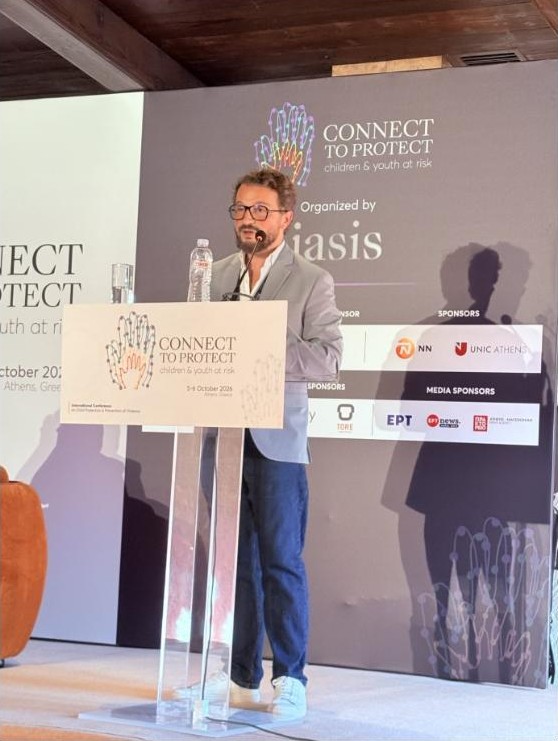
At the “Connect to Protect” international conference in Athens, speaker Cédric Foussard addressed the development of juvenile justice and the introduction of child-centred approaches, presenting the shift from child-friendly justice to child-centred justice.
The key question of his speech was whether existing justice systems are truly built around children’s rights, developmental characteristics and needs.
The difference between child-friendly and child-centred justice
Child-friendly justice means adapting existing legal procedures to the child’s age, level of development and needs.
However, the speaker emphasised a broader change: the development of child-centred justice.
This approach rethinks not only the way children take part, but the structure of the whole system — from the first contact through investigation, decision-making and follow-up support.
The aim is for the justice system to see the child as a rights holder and as a person with specific developmental characteristics.
Adolescent development
The speaker addressed the specific features of adolescents’ behaviour and decision-making.
He explained that during adolescence, emotional responses, peer influence and the ability to assess long-term consequences can play a major role in shaping behaviour.
The response to a child who has committed an offence should therefore take into account not only the act itself, but also the child’s developmental stage and their family and social environment.
It was stressed that some offending behaviour can be temporary.
An overly punitive approach can contribute to negative labelling of the child and to difficulties with their later social inclusion.
Changing the questions professionals ask
The speaker proposed looking at a child’s behaviour in a broader context.
Instead of focusing only on the offence, it is necessary to understand who the child is, what experiences they have had, what circumstances led to the situation and what support they need.
This makes it possible to respond not only to the consequences of the offence, but also to the possible causes behind the child’s behaviour.
Manchester’s Participatory Youth Practice
The “Participatory Youth Practice” approach used in Manchester was presented.
It emphasises the child’s genuine participation, exploring the reasons behind behaviour, building trust in professional relationships and identifying the child’s goals for the future.
Key principles include avoiding an excessive focus on threat and punishment, developing the child’s ability to make independent decisions and giving them the chance of a fresh start.
Scotland’s experience
The speaker also discussed the reforms of Scotland’s youth justice system.
He presented approaches based on early intervention, diverting children from formal criminal justice processes wherever possible, and using deprivation of liberty only as a measure of last resort.
Cooperation between agencies was also highlighted, so that the child receives the social, educational and psychosocial support they need.
Children’s participation in justice system reform
The speech stressed that children’s participation should not be limited to their individual cases.
Children and young people can be involved in designing justice services, procedures and policies.
Their experiences can help reveal which parts of the current system are confusing, frightening or insufficiently supportive.
Excerpts from the speech
Today I would like to present a slightly different perspective on the child justice system, focusing more on the part of criminal justice that concerns children in conflict with the law, and to take you through a reflection: from “child-friendly justice” to “child-centred justice”.
Child justice is not a secondary or marginal field. We are talking about a huge share of the world’s population — around 2.3 billion children.
As defined in the UN Convention on the Rights of the Child (UNCRC), a child is a person aged 0 to 18. Under the Convention there is no separate legal category of “youth”: there is the child, and then the adult. In other words, every person under 18 is a child and has special rights.
This is roughly one third of the world’s population. In some countries children make up as much as 40% of the population. And if we add young adults up to 25, in some countries this group can reach 50, 55 or even 60 percent — for example in Pakistan, Egypt and elsewhere.
So we are not talking about a narrow or niche field, but about a system that concerns a very large part of the population in most countries.
Turning to justice, let me share the research of Keenan and White, which shows very well that offences committed by children are episodic, meaning they usually happen once or twice. They are also transitional: they peak at around 14–17 and then naturally decline. And they are often opportunistic, meaning not planned in advance.
For example, there may be peer pressure: “I was with my friends, the window was open, we decided to go in and take the computer or the cat.”
We also have a UNICEF study from a few years ago showing that 90% of children in conflict with the law are first-time offenders. And of those 90%, 80% never offend again — regardless of what measures we take.
That means we need to think about what response we should give to the situation at this stage of the child’s development.
The results are quite impressive. Since 2011 they have recorded:
- an almost 90% reduction in referrals of children aged 12–15,
- a 93% reduction in convictions of 16–17-year-olds,
- and an almost 98% reduction in custodial sentences.
I know this sounds a bit like Latin American election results, but really — a 98% reduction in custodial sentences.
As a result, since children were no longer being held in detention, or at least in young offender institutions, they decided to close and abolish that kind of detention for children under 18. Those institutions were in fact very similar to prisons.
You know, good practice matters, and we need to innovate. Today that is quite difficult, especially with budget cuts happening everywhere. It is very hard to keep innovating. But we must draw inspiration from experience in different countries and systems around the world, and try.
However, the issue here is not just running one pilot project or having one good practice. What matters is that the practice becomes the rule.
And I would like to say that we have worked for a very long time on introducing child-friendly justice at the level of procedures. I think it is now time to develop a more systemic commitment, putting the child at the centre of the system. And we already have evidence that it works.
Key conclusion
Child-centred justice aims not only to protect children’s rights in legal proceedings, but also to support their recovery, development and full inclusion in society.
This approach is also important for developing a justice system in Armenia that involves children and for improving procedures in line with children’s best interests.